
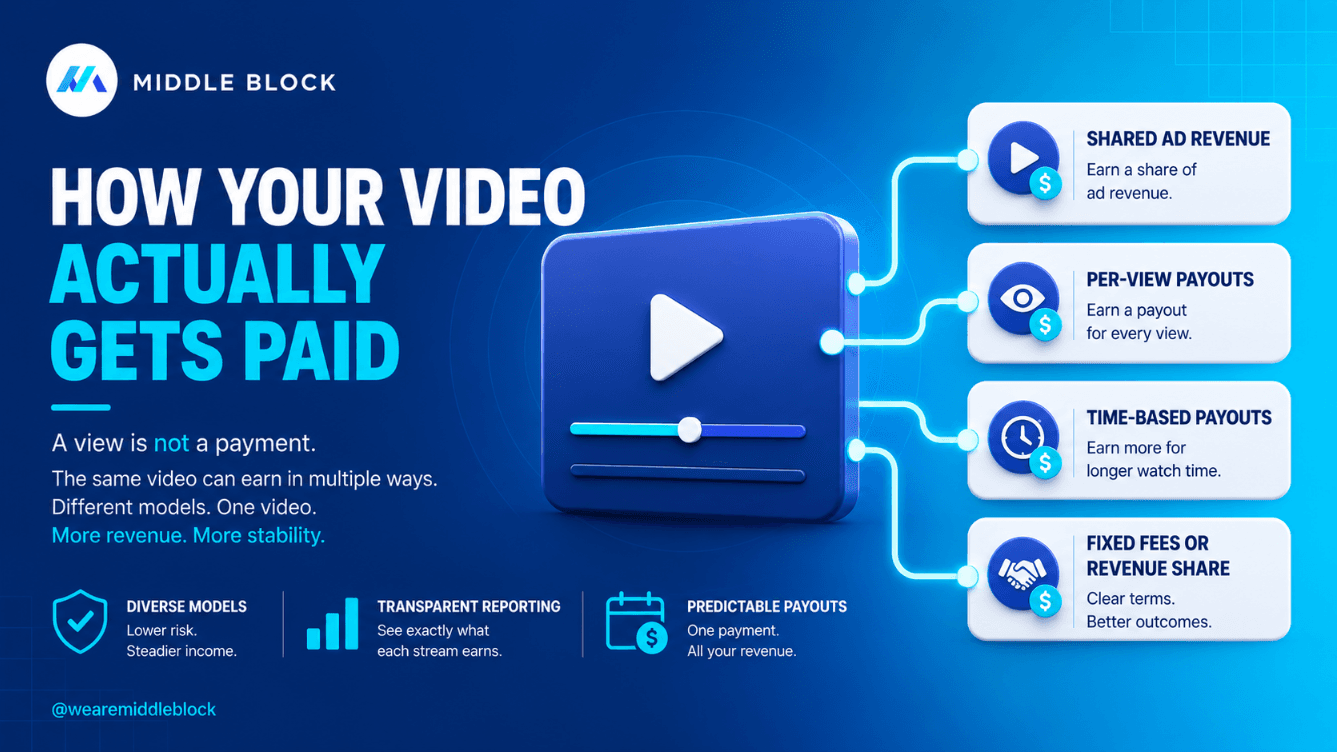
Ask most people how a video makes money, and the answer is some version of "views." More views, more money. It is a reasonable guess, and it is also incomplete enough to be misleading. A view is not a payment. It is what happens just before one, and the amount that follows depends entirely on the model underneath.
Once your video is distributed beyond your own channel, it can earn in several different ways at once, and they do not all work the same. Understanding them is the difference between guessing at your revenue and actually managing it.
First, the thing all of it rests on: licensing
Before any of the models make sense, it helps to name what syndication actually is. Syndication is licensing your video to third-party platforms that serve it to their own audiences. You supply the content. They supply the audience and the monetization. In most cases those platforms run ads against your video and share the ad revenue with you.
That is the foundation. Everything below is a variation on how that value comes back to you.
The models, and how each one pays
Shared ad revenue. The most common model. Your video runs on a platform, ads run alongside it, and you get a share of that ad revenue. What you earn here is tied to a CPM, the rate advertisers pay per thousand impressions, which is why the same view can be worth very different amounts depending on where it happens. A premium environment commands a higher rate than a low-value one.
Per-view payouts. In some publisher-network distribution, you earn a payout per view rather than a share of a specific ad. It is a simpler, more direct relationship between how many times your video is watched and what you are paid.
Time-based payouts. In subscription environments, the math changes again. Instead of paying per impression, some products pay based on watch time inside the subscription. Here, a video that holds attention for longer earns more, even from the same number of viewers.
Fixed fees or revenue share. Above the individual placement, the network relationship itself has terms. Some arrangements charge fixed fees, some take a revenue share, and some bundle both. This is the part worth reading closely, because it quietly shapes everything you take home.
Why the mix matters more than any single model
Here is the useful part. Because these models behave differently, spreading one video across several of them is not just about earning more. It is about earning more steadily.
Ad rates rise and fall. Subscription products change terms. A single publisher can shift its priorities. But when the same piece of content is earning through shared ad revenue, per-view payouts, and time-based payouts at the same time, no single change controls your whole income. One piece of content, multiple monetization paths, lower dependence on any one of them.
That is the quiet logic behind distributing widely rather than deeply. It is not only reach. It is resilience.
One warning worth taking
Because the models differ, the terms differ too, and the terms are where revenue is quietly won or lost. Before you sign with any network, get the revenue model in writing. Know whether you are looking at fixed fees, a revenue share, or a bundle of both, and what your cut actually is. A great distribution deal with unclear terms is not a great deal.
Where Middle Block fits
Middle Block is built to let one video earn across all of these models without you managing each one by hand. Through a single integration, your content is distributed across CTV, editorial platforms, and publisher networks, each with its own way of paying. Transparent monthly reporting breaks down views, CPM, and revenue by destination, so you can see exactly what each model is producing rather than trusting a single blended number. And revenue management means payouts from those different sources arrive predictably, instead of as a pile of separate, hard-to-reconcile statements.
You keep making video. The network turns it into several kinds of income and makes that income legible.
The bottom line
A view is not a payment, it is a promise of one, and the value of that promise depends on the model behind it. The publishers who earn the most are not chasing raw views. They are letting one video get paid in several ways at once, reading their terms carefully, and watching what each source actually produces.
If you want your video earning across every model that fits it, talk to our team about Middle Block.
— ABOUT THE AUTHOR

Marom Yvgi
BizDev
Marom has years of experience in business development with demonstrated skills establishing opportunities in video production and digital video publishing.
Connect on LinkedIn— READ NEXT
More from the team.


— LOOKING FOR SOMETHING SPECIFIC?
Talk to our team.
If you have questions about content syndication, partnerships, or the platform — we're here.