
Why Non-Exclusive Is the Only Video Syndication Model Worth Signing

Yaly Sami
Operations and Accounts
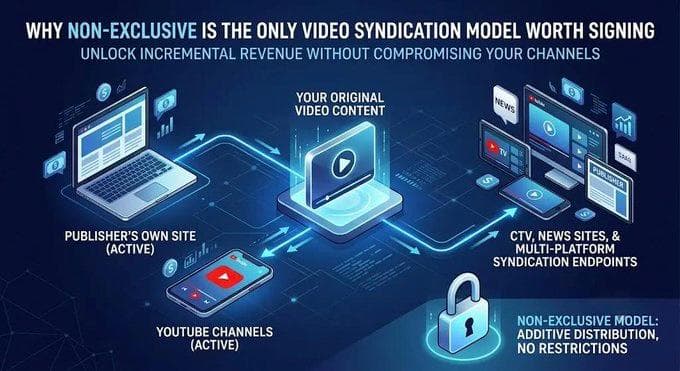
If you produce video, you've probably heard the pitch for syndication, distribute your content across MSN, Yahoo, Apple News, CTV channels, and thousands of publisher endpoints that serve it to their own audiences. And somewhere behind the interest, there's usually a quiet worry: won't this cannibalize what I already earn?
It's a fair question. It's also the most important one, because the answer depends entirely on a single word in the contract: exclusive, or non-exclusive. The network you join matters less than the model you sign under.
What "non-exclusive" actually means
A non-exclusive syndication model means you grant the right to distribute your video, you don't hand over the video. You keep it. You keep running it on your own site. You keep it on YouTube. You keep it in your sponsorship deals and your direct sales. Syndication runs alongside everything you already do, not instead of it.
An exclusive model does the opposite. It asks you to lock a piece of content to one distribution path, which means every dollar it earns there is a dollar it can't earn anywhere else. For most publishers, that's not distribution — it's a constraint dressed up as an opportunity.
Why syndication revenue is additive, not substitutive
The instinct that syndication "steals" views comes from thinking about a single screen. But your video and its syndicated placements almost never compete for the same viewer at the same moment.
Your on-site player reaches people who came to you. A CTV placement reaches someone on their living-room TV. A placement inside an MSN article reaches a reader who was never going to visit your site that day. These are different surfaces, different audiences, and different advertising demand, which is exactly why the revenue stacks instead of splitting.
The same clip, distributed across dozens of endpoints, earns from every placement at once. And because well-made video holds attention, it tends to earn at the higher end of the CPM range on each one. That's not a redistribution of what you already make. It's incremental revenue on work that's already done.
The channels a good deal never touches
Under a genuinely non-exclusive model, the following stay entirely yours, untouched:
- Your own site. Your player, your ad stack, your audience, unchanged.
- YouTube and your owned channels. No conflict, no takedowns, no competing claims.
- Sponsorships and branded deals. The video you made for a sponsor stays theirs; syndication never overrides those terms.
- Direct sales. Any relationship you sell yourself remains 100% yours.
If a syndication partner asks you to give up any of these, that's not a non-exclusive deal — no matter what the first page of the contract calls it.
How to spot an exclusive deal in disguise
Not every restrictive deal announces itself. Before you sign, ask:
- Can I keep running this exact video everywhere I run it today? The answer should be an unqualified yes.
- Do I retain the right to syndicate the same content through other partners? True non-exclusivity means you're never locked to one network.
- Who controls takedowns? You should be able to pull any video, from any endpoint, whenever you choose.
- Is the reporting per-platform? If you can't see what each placement earns, you can't tell whether the deal is actually additive, you're taking it on faith.
A partner confident in the value they add has no reason to lock you in. The lock-in is usually a sign the value isn't there without it.
Where Middle Block fits
Middle Block is non-exclusive by design. You keep every channel you have today, your site, YouTube, sponsorships, direct deals, and syndication runs on top of all of it. One feed handles distribution across editorial platforms, CTV channels, and 1,000+ publisher endpoints, in the format each partner requires. Transparent, per-platform reporting shows exactly what every integration earns, so "incremental" isn't a promise you have to trust, it's a number you can watch.
Nothing you already do changes. Something new simply gets added to it.
The bottom line
The best syndication deal is the one that costs you nothing you already have. It doesn't ask for exclusivity, doesn't touch your existing revenue, and doesn't make you choose between reach and control. It just adds another layer of earnings to video you've already produced.
Engineer the video once. Distribute it everywhere. Keep everything you built. If that's the model you want, talk to our team about Middle Block.
— ABOUT THE AUTHOR
Yaly Sami
Operations and Accounts
Yaly has been managing platform operations for several years and knows the system inside and out — fueled by a bit too much coffee.
Connect on LinkedIn— READ NEXT
More from the team.


— LOOKING FOR SOMETHING SPECIFIC?
Talk to our team.
If you have questions about content syndication, partnerships, or the platform — we're here.