One Algorithm Change Away: Why Video Needs More Than One Platform

Daria Kabzina
Content Recruitment
Every publisher and creator knows the feeling. One morning a platform changes its algorithm, or its payout terms, or its policy, and overnight the reach and revenue you counted on are simply different. You did not change anything. The ground under you did.
That is the quiet risk at the center of most video businesses, and it has almost nothing to do with the quality of the video. It is a structural problem. When both your reach and your revenue come from a single platform, you are one algorithm change away from a significant disruption, and there is very little you can do about it after the fact.
Why single-platform dependence is so fragile
The danger is not that any one platform is bad. It is that relying on one platform ties two different things, how many people see your video and how much you earn from it, to the same single point of failure.
If that platform tweaks its feed, your reach drops. If it changes its monetization, your income drops. If it decides your category is no longer a priority, both drop at once. You become a passenger in someone else's business decisions, and those decisions are made without you in the room.
For a hobby, that is annoying. For a business, it is an existential risk sitting quietly in the background.
Diversification is the answer, not abandonment
The fix is not to walk away from the platform that works for you. It is to stop letting it be the only thing that works for you.
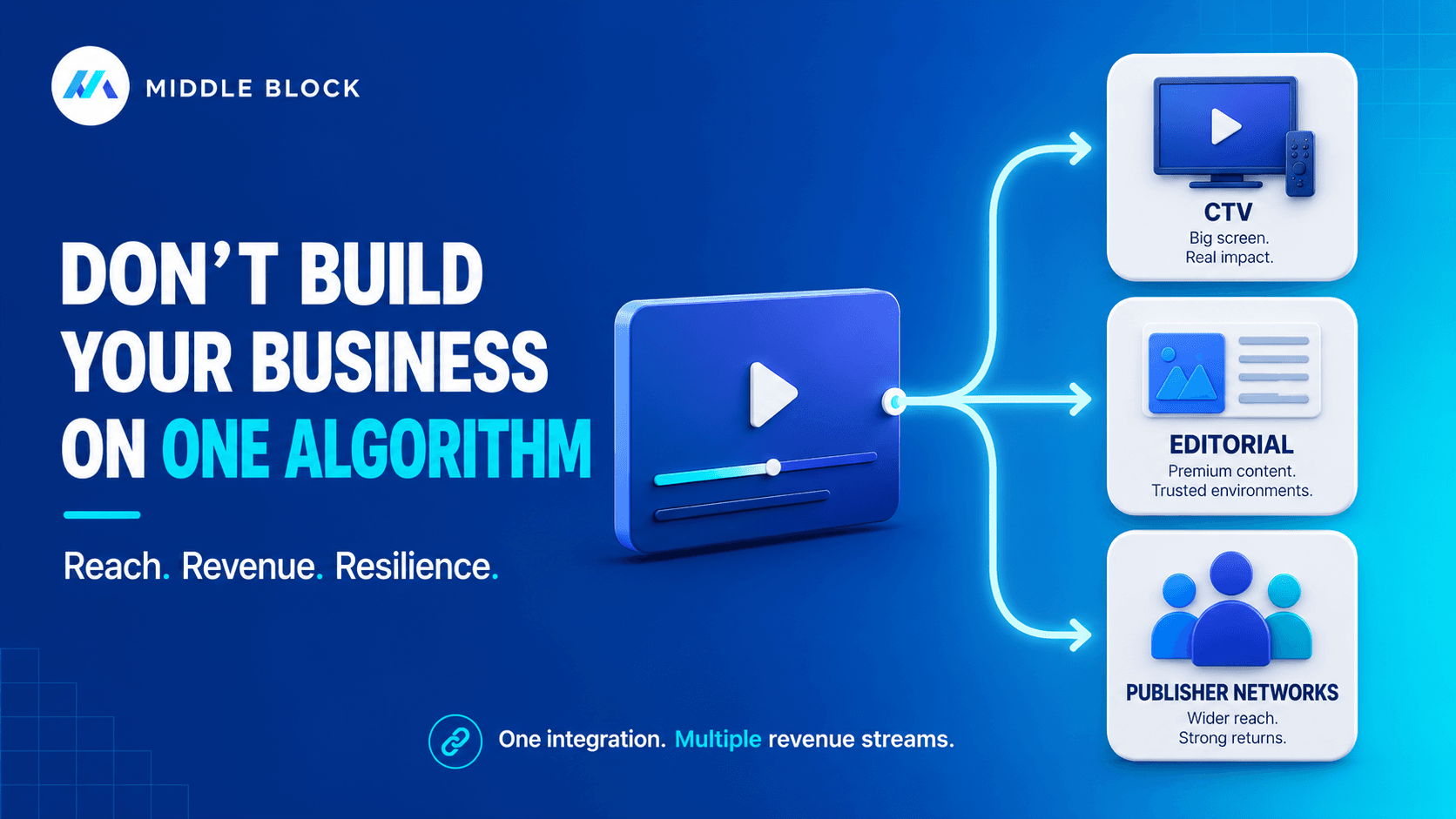
The healthier model is to build parallel revenue streams across several distinct types of destination, each with a different risk profile, so that no single change can take down the whole business. When your video earns in more than one place, an algorithm change on any one of them becomes a bad week, not a catastrophe.
Think of it as the same principle that applies to any serious business. You do not want a single customer, a single supplier, or a single channel to be able to end you.
What multiple revenue streams actually look like
Diversification sounds abstract until you see it in practice. The same piece of video can earn in several different ways at once:
Connected TV. Ad impressions from your video running on a CTV channel, on the largest screen in the household.
Editorial placements. Your video running inside articles on major editorial sites, with shared ad revenue.
Publisher networks. Distribution across publisher networks earning per-view payouts.
Subscription products. Time-based payouts from subscription environments, where you earn based on watch time rather than impressions.
That is one piece of content, several monetization paths, and much lower dependence on any single one. None of it requires new production. It is the video you already made, simply earning in more places.
The part that makes this practical
The reason this used to be hard is that reaching all of those destinations meant separate integrations, separate formats, and separate relationships. Most teams could not justify the work, so they stayed on one platform by default and inherited the risk that came with it.
That is no longer the tradeoff. A single integration can now put your existing video across many destinations at once, which means diversification is finally something you can do without building an operations team around it.
Where Middle Block fits
Middle Block exists to make that spread of revenue simple. Through one integration, your existing video is distributed across CTV, editorial platforms, and publisher networks, each a separate stream with its own risk profile, and all of it non-exclusive, so the channels you already rely on stay exactly as they are. You choose how the content earns, whether programmatic, fixed licensing, or a hybrid, and Middle Block handles the distribution, with transparent monthly reporting so you can see what each stream produces.
The result is a video business that does not live or die by any single platform's next decision.
The bottom line
The biggest risk in video is rarely the video. It is depending on one place to show it and to pay for it. Keep the channels that work for you, and add parallel streams alongside them, so that when a platform inevitably changes the rules, it costs you a week instead of your business.
If you want your video earning across more than one platform, talk to our team about Middle Block.
— ABOUT THE AUTHOR
Daria Kabzina
Content Recruitment
Daria has been working with content creators for the past few years with extensive experience in social networking and communications.
Connect on LinkedIn— READ NEXT
More from the team.


— LOOKING FOR SOMETHING SPECIFIC?
Talk to our team.
If you have questions about content syndication, partnerships, or the platform — we're here.