
Fresh Video Usually Wins, But Not Always: When Recency Matters and When It Does Not

Yaly Sami
Operations and Accounts
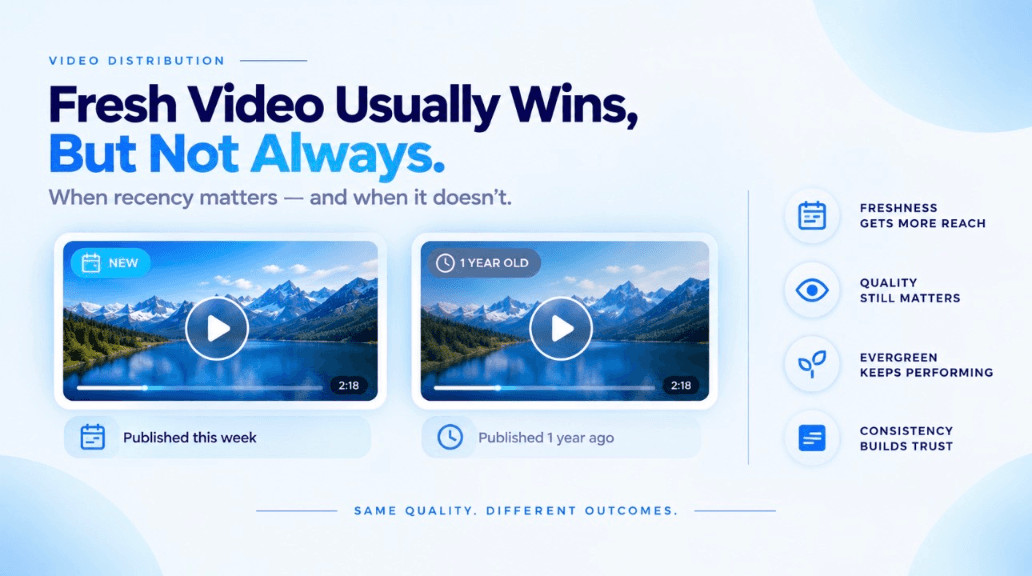
Picture two videos of equal quality. Same production value, same usefulness, same polish. One was published this week. The other has been sitting in your library for a year. On most premium platforms, the new one will often get more distribution and more visibility than the old one, and the gap is not small.
That can feel unfair. The old video is just as good. But it points to something worth understanding: on these platforms, quality and recency are two separate levers, and recency does a lot of quiet work that quality alone cannot. With one important exception we will get to.
Why platforms are built around freshness
Editorial platforms are, at their core, in the business of what is current. A platform like MSN wants editorial-fresh playlists organized by category, feeds built to show readers what is relevant now. That is the product they are offering their audience.
A timely video from a year ago does not fit an editorial-fresh slot the way a new one does, no matter how good it is. Content on these platforms is often grouped not just by topic and audience but by freshness itself. Recency is not a tiebreaker at the margins. It is one of the ways your content is sorted in the first place.
Cadence beats the one-off
This is why a single brilliant video, followed by silence, tends to underperform a steady stream of solid ones.
Platforms reward a regular, consistent publishing cadence. A steady flow of new video keeps you continuously present in the fresh playlists and the current-content slots. Publish once and stop, and you appear briefly and then quietly fall out of those slots as newer content takes your place. Publish consistently, and you hold your position in the rotation week after week.
In other words, freshness is not a property of a single video. It is a property of a habit.
Consistency compounds
There is a second reason cadence matters, and it is about trust. Consistency in your publishing schedule builds trust and loyalty over time, with audiences who learn what to expect from you, and with platforms that learn you are a reliable source of current content.
A reliable feed is an easier feed to feature. When a platform knows fresh, quality video will keep arriving from you, keeping you in its current-content lineups becomes low-risk. That trust, earned through consistency, is worth more over time than any single standout upload.
Fresh is a lever, not a rule
Now the important clarification, because "newer always wins" is too simple. Not all content ages the same way. Some video is evergreen: how-to guides, explainers, and foundational topics that stay relevant for years. A strong evergreen video from a while back can keep performing and keep earning long after it was published, because the thing it covers has not changed.
So freshness is a lever, not an iron rule. For timely, news-driven, or trend-based content, recency matters enormously, and being current is most of the battle. For evergreen content, staying power matters more than a publish date, and the goal is to keep it discoverable rather than to constantly replace it.
The real takeaway is to match the approach to the content. Keep timely topics flowing on a steady cadence so you hold your place in the fresh rotation. And keep your evergreen library well described and well distributed so it stays findable for as long as it stays relevant. Quality is necessary either way. Freshness is the lever you reach for most with timely content, and less with content that does not age.
Where Middle Block fits
Handling both of these at once, a steady flow of timely video and a deep evergreen library, sounds like a lot of manual upkeep, and done by hand, it is. This is exactly the part Middle Block automates. It organizes and compiles your content into the playlist structures each platform expects, including the editorial-fresh, category-based playlists that platforms like MSN want, and it does this on an ongoing basis. New timely videos flow into the current-content slots automatically, while your evergreen content stays organized and discoverable across the network, without anyone rebuilding feeds for each destination.
You keep publishing. The network makes sure your timely video lands in the fresh rotation and your evergreen video keeps working, everywhere it should.
The bottom line
Two videos of equal quality do not always share the same fate. For timely content, premium platforms reward freshness and a steady cadence, so recency does real work that quality alone cannot. For evergreen content, an older video can keep winning as long as the topic stays relevant. Keep the quality high, keep timely content coming, and keep your evergreen library findable. Freshness is the lever most publishers underuse, and knowing when not to reach for it is part of using it well.
If you want your timely video in the fresh rotation and your evergreen video still working across the platforms that matter, talk to our team about Middle Block.
— ABOUT THE AUTHOR
Yaly Sami
Operations and Accounts
Yaly has been managing platform operations for several years and knows the system inside and out — fueled by a bit too much coffee.
Connect on LinkedIn— READ NEXT
More from the team.

— LOOKING FOR SOMETHING SPECIFIC?
Talk to our team.
If you have questions about content syndication, partnerships, or the platform — we're here.