
MRSS Feed Creation: What It Is and Why Every Publisher Needs One

Yaly Sami
Operations and Accounts
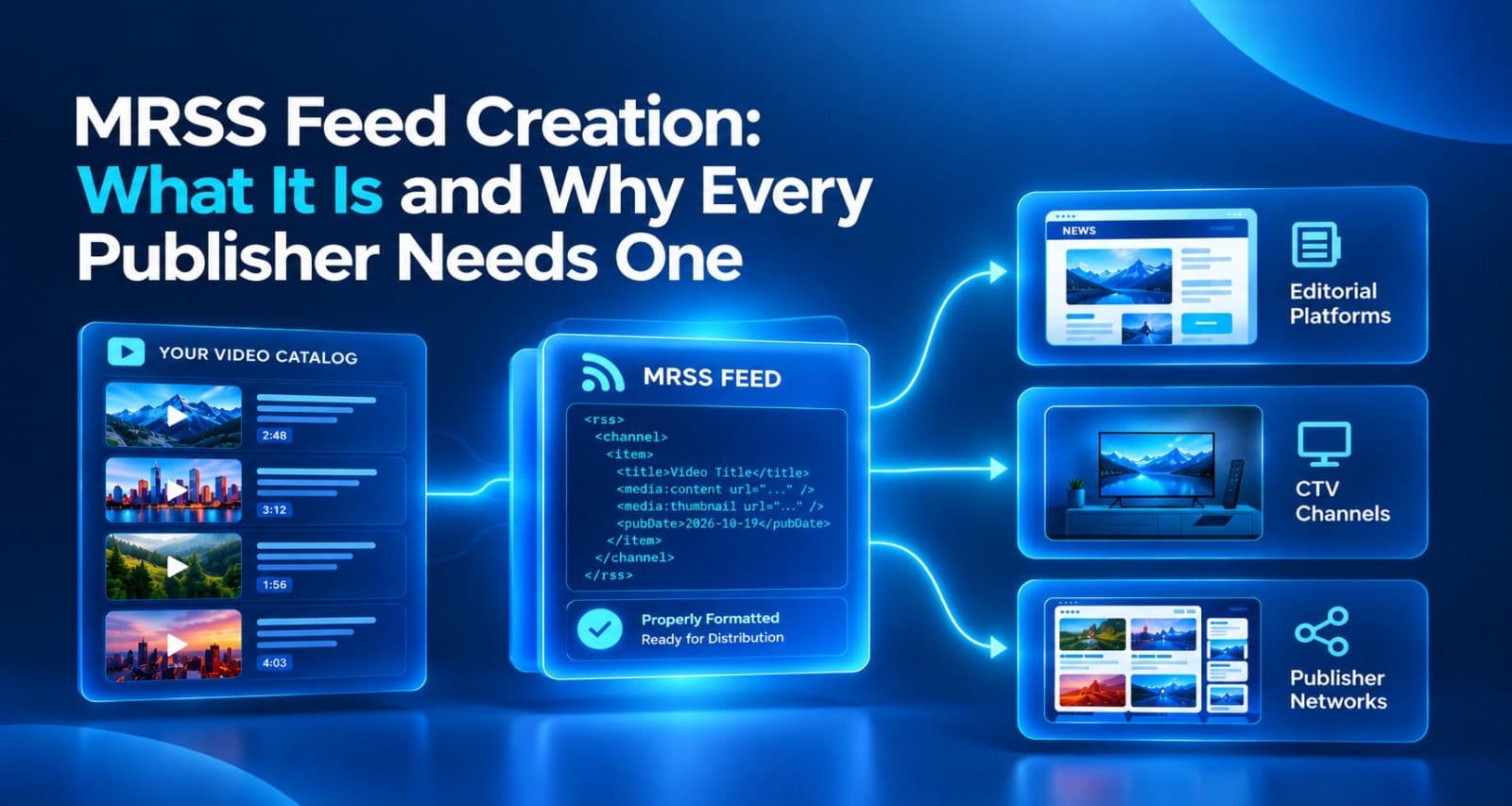
If you want your video to reach audiences beyond your own channel, one thing has to exist first: an MRSS feed. It is the technical mechanism for distribution, the piece that carries your video out to editorial platforms, CTV channels, and publisher networks. Without it, your video stays where it was published. With it, your content can travel everywhere automatically.
That makes MRSS feed creation one of the most important, and most overlooked, steps in getting video distributed. Here is what an MRSS feed actually is, what creating one involves, and why every publisher serious about reach needs one.
What an MRSS feed is
An MRSS feed is the technical mechanism that lets publishers automate video distribution at scale. Instead of manually uploading your video to each destination, you expose one structured feed, and the platforms that carry your content read from it.
The payoff is in what that automation removes. A feed means no manual uploads, real-time updates as you publish, and consistent metadata across every platform. Publish a new video, and it flows into the feed and out to every connected platform, without anyone re-uploading anything. That is the core of why MRSS exists: it turns distribution from a manual chore into something that simply runs.
What MRSS feed creation actually involves
Creating a feed is not just listing your videos. The feed has to be properly formatted, because platforms depend on it being structured exactly the way they expect. A valid feed carries the required elements for each video, including its media content and thumbnail, so a receiving platform has everything it needs to display and serve the video correctly.
There is also a complication worth knowing up front. Most receiving platforms use MRSS, but each has its own variations. A feed is not strictly one-size-fits-all, so MRSS feed creation also means handling the format differences between platforms, and keeping the feed current as you publish and as specs change over time.
In other words, creating an MRSS feed is less a one-time task and more a system that has to be built correctly and maintained.
Why this used to be hard, and is not anymore
It is worth understanding how much this has changed. A few years ago, video syndication required custom MRSS feed development, platform-specific format variations, and ongoing maintenance as specs changed. Creating and maintaining feeds was a genuine engineering project, which is exactly why most publishers never did it, and why so much good video never left the channel it was published on.
Today, that barrier has collapsed. A properly formatted MRSS feed and a distribution partner is enough to reach major platforms. Feeds can be generated automatically from your video catalog, which means MRSS feed creation is no longer reserved for publishers with dedicated infrastructure teams.
The two ways to create an MRSS feed
When it comes to actually creating the feed, there are two real paths.
Build it yourself. If you have engineering resources, you can build MRSS feeds from your own CMS and manage the format variations each platform requires. This gives you full control, and it suits very large publishers with dedicated infrastructure teams. The trade-off is ongoing engineering cost, which for most publishers outweighs the value of doing it in-house.
Generate it automatically. The alternative is to use a platform that generates the feed automatically from your catalog, handling the formatting, the per-platform variations, and the maintenance for you. This is how most publishers approach it now, because it converts what used to be an ongoing technical project into something managed.
Why every publisher needs one
The reason this matters to every publisher is simple. An MRSS feed is the thing that stands between your video and every platform that could carry it. No feed, no distribution. A feed, and the same video you already made can reach editorial platforms, CTV channels, and publisher networks, automatically and continuously.
It is the difference between video that lives on one channel and video that works across the market. For any publisher who wants reach beyond their own audience, the feed is not optional. It is the foundation.
Where Middle Block fits
Middle Block handles MRSS feed creation for you. You bring your existing video catalog, and Middle Block generates a properly formatted feed, applies the variations each partner requires, and keeps it current as you publish. The same feed then distributes your video across editorial platforms, CTV channels, and publisher networks, with reporting consolidated in one place.
You never build or maintain the feed yourself. It is created, formatted, and kept valid in the background, so your video stays distributed without the technical project that used to come with it.
The bottom line
MRSS feed creation is the step that turns your video from something stuck on one channel into something that can travel everywhere. The feed is the technical mechanism that automates distribution at scale, with no manual uploads and consistent metadata across platforms. You can build it yourself if you have the engineering team, or generate it automatically and focus on making video. Either way, every publisher who wants real reach needs one.
If you want your MRSS feed created and maintained automatically, talk to our team about Middle Block.
— ABOUT THE AUTHOR
Yaly Sami
Operations and Accounts
Yaly has been managing platform operations for several years and knows the system inside and out — fueled by a bit too much coffee.
Connect on LinkedIn— READ NEXT
More from the team.


— LOOKING FOR SOMETHING SPECIFIC?
Talk to our team.
If you have questions about content syndication, partnerships, or the platform — we're here.