
How Article-to-Video Helps Publishers Turn Every Story Into a Video

Yaly Sami
Operations and Accounts
Every publisher knows the math by now. Articles with video earn more, retain readers longer, and get better placement on social and in search. Audiences expect it. Advertisers pay for it.
The problem isn't whether to make video. It's how to make video for every article you publish — without hiring a production team, buying editing software, or slowing down your editorial cadence.
That's the gap Middle Block's Article-to-Video feature is built to close.
What Article-to-Video actually does
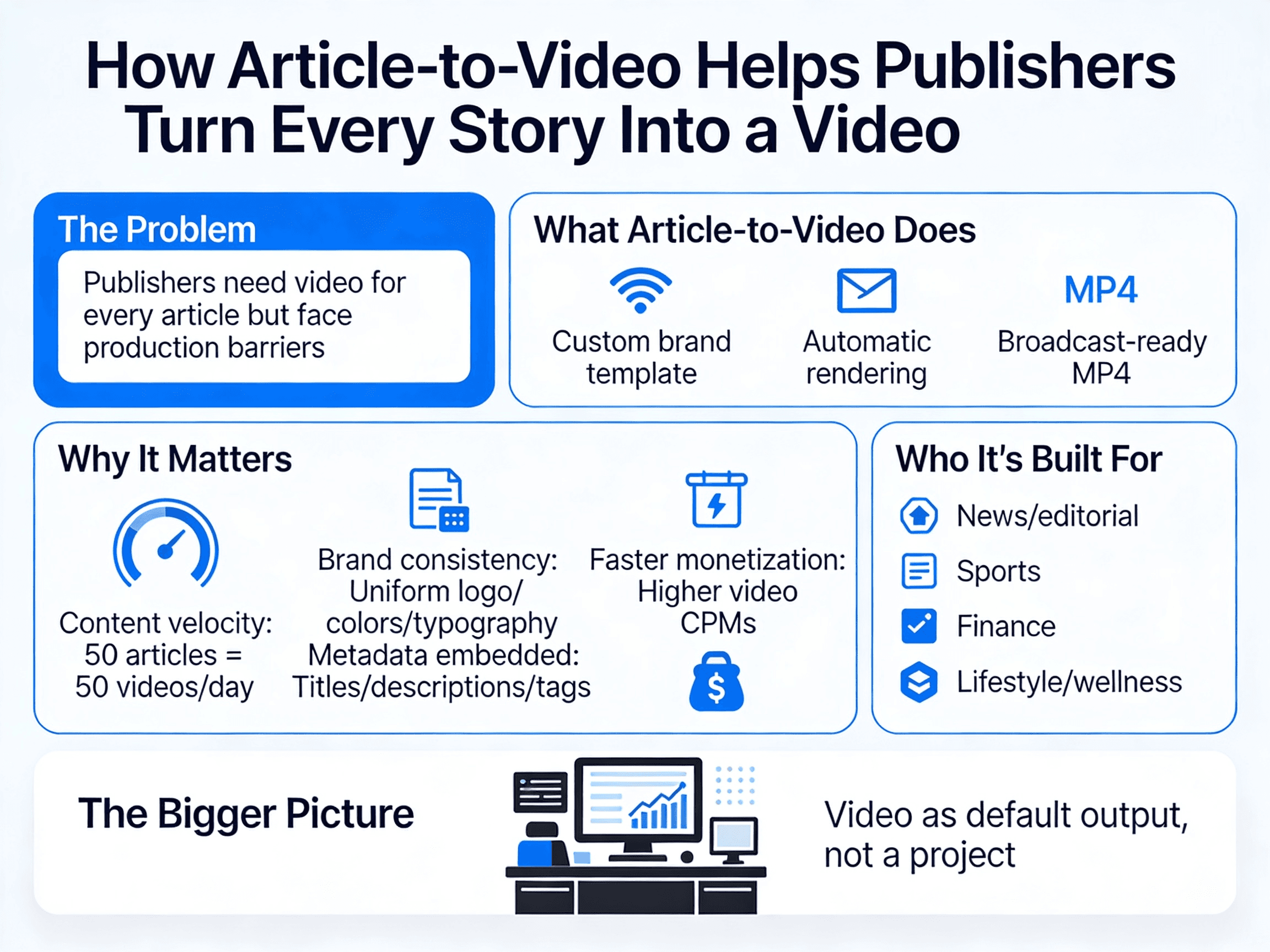
You share an RSS feed or article section. Our team designs a custom video template that matches your brand — logo, colors, typography, motion. From that point on, every new article you publish gets rendered into a broadcast-ready MP4 automatically, usually within hours.
Title cards, image transitions, metadata, music — all handled by the pipeline. No editing, no production handoff, no manual uploads. The output flows directly into your video library and into MRSS feeds, ready for distribution across the syndication network the moment it's rendered.
One template up front. Infinite videos after that.
Why it matters for publishers
A few practical reasons this changes how editorial teams think about video.
Content velocity stops being a bottleneck. If you publish 50 articles a day, you get 50 videos a day. If you publish 5, you get 5. The pipeline scales with your editorial output instead of fighting it.
Brand consistency is built in. Because the template is designed once and reused forever, every video that comes out looks like it belongs to you. No drift, no off-brand thumbnails, no inconsistent typography across a week of breaking news.
Metadata travels with the video. Titles, descriptions, tags — all extracted from the source article and embedded in the output. That matters for contextual placement, for SEO on your own pages, and for how the video performs once it's syndicated.
Monetization gets faster. Video CPMs are higher than display, and pre-roll on an article-companion video is some of the most valuable inventory a publisher has. Article-to-Video shortens the path from publishing a story to earning on it.
Who it's built for
The pipeline doesn't care what vertical you're in. News and editorial teams use it for breaking stories, opinion pieces, and analysis. Sports publishers use it for recaps and previews. Finance sites turn market commentary into daily video briefings. Lifestyle and wellness publishers feed evergreen articles through it to build a back catalog over time.
The common thread: publishers who treat video as a continuous content stream, not a one-off project.
The bigger picture
Most publisher video strategies die in the same place — somewhere between "we should have video on every article" and "we don't have the staff for that." Automation isn't a workaround for that gap. It's the answer.
Article-to-Video isn't trying to replace original production. It's trying to make sure that every story you already write gets a video version, on-brand and on-time, without anyone having to open an editor. The articles keep coming. The videos keep coming with them.
That's the goal: video as a default output of the newsroom, not a project the newsroom has to staff for.
— ABOUT THE AUTHOR
Yaly Sami
Operations and Accounts
Yaly has been managing platform operations for several years and knows the system inside and out — fueled by a bit too much coffee.
Connect on LinkedIn— READ NEXT
More from the team.


— LOOKING FOR SOMETHING SPECIFIC?
Talk to our team.
If you have questions about content syndication, partnerships, or the platform — we're here.