
What Is Vertical Video Syndication? A Simple Breakdown

Marom Yvgi
BizDev
Vertical video used to be the thing you got teased for filming at concerts. Now it's the dominant format on every platform that matters — TikTok, Reels, Shorts, Snap, and increasingly the video players embedded inside news articles. Audiences scroll vertically. Publishers know it. Advertisers are following.
But there's a gap between making vertical video and actually getting it in front of people at scale. That's where vertical video syndication comes in.
What is vertical video syndication?
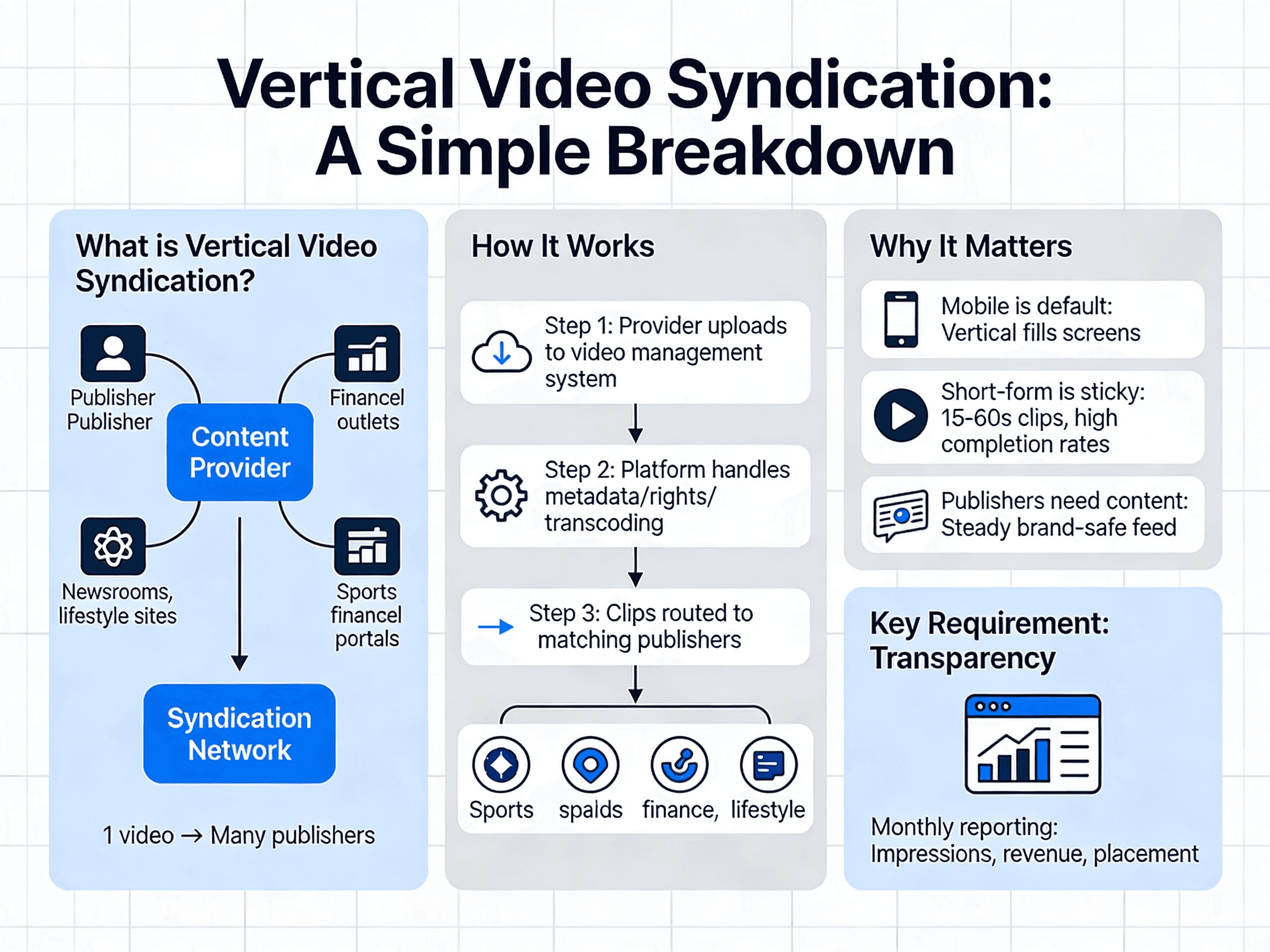
Syndication is the distribution side of the equation. A content provider produces a video once, and a syndication network routes it to many publishers — newsrooms, lifestyle sites, sports outlets, finance portals — who embed it on their pages alongside their own editorial. Each side gets something they couldn't get alone: providers get reach, publishers get fresh inventory, and audiences get video that's actually relevant to what they're reading.
Vertical video syndication applies that same model to the 9:16 frame. Instead of horizontal players that get awkwardly stuffed into mobile layouts, vertical clips slot into in-article placements, story rails, and side units that feel native to how people already scroll. The format is the format the viewer expects.
How vertical video syndication works
The mechanics are straightforward. A provider uploads originals into a video management system. The platform handles metadata, rights, pacing, and transcoding. From there, vertical-ready clips get routed through a syndication network to publishers who've opted into matching categories — sports highlights to sports sites, market explainers to finance sites, beauty tutorials to lifestyle sites.
Reporting flows back monthly through a dedicated dashboard so everyone can see impressions, revenue, and where things landed.
Why vertical video syndication matters
A few things shifted at once, and vertical syndication sits at the intersection.
Mobile is the default. Most article traffic is now mobile. A horizontal player on a phone is a player that gets ignored. Vertical fills the screen, which is what advertisers are paying for.
Short-form is sticky. Vertical clips are typically 15 to 60 seconds — long enough to deliver a story, short enough to finish. Completion rates are stronger, which means CPMs are stronger, which means publishers earn more per impression.
Publishers can't make all their own video. Newsrooms are leaner than they used to be. A vertical syndication feed gives them a steady stream of brand-safe, contextually-relevant clips without staffing up a video desk. Providers, meanwhile, get distribution they'd never close one-by-one through individual deals.
The piece that ties it together
The fundamental requirement is transparency. Syndication only works when both sides can see what happened — which clips ran where, how they performed, what revenue accrued. Without that, it's just guesswork. With it, vertical video stops being a format experiment and starts being a real distribution channel.
At Middle Block, that's the bet we've been making: route premium video — vertical included — through one pipe, match it to the right publishers, and report on it cleanly. The format keeps changing. The fundamentals don't.
— ABOUT THE AUTHOR
Marom Yvgi
BizDev
Marom has years of experience in business development with demonstrated skills establishing opportunities in video production and digital video publishing.
Connect on LinkedIn— READ NEXT
More from the team.




— LOOKING FOR SOMETHING SPECIFIC?
Talk to our team.
If you have questions about content syndication, partnerships, or the platform — we're here.