
Video Syndication in 2026: Why It's Easier (and More Valuable) Than Ever

Marom Yvgi
BizDev
# Video Syndication in 2026: Why It's Easier (and More Valuable) Than Ever
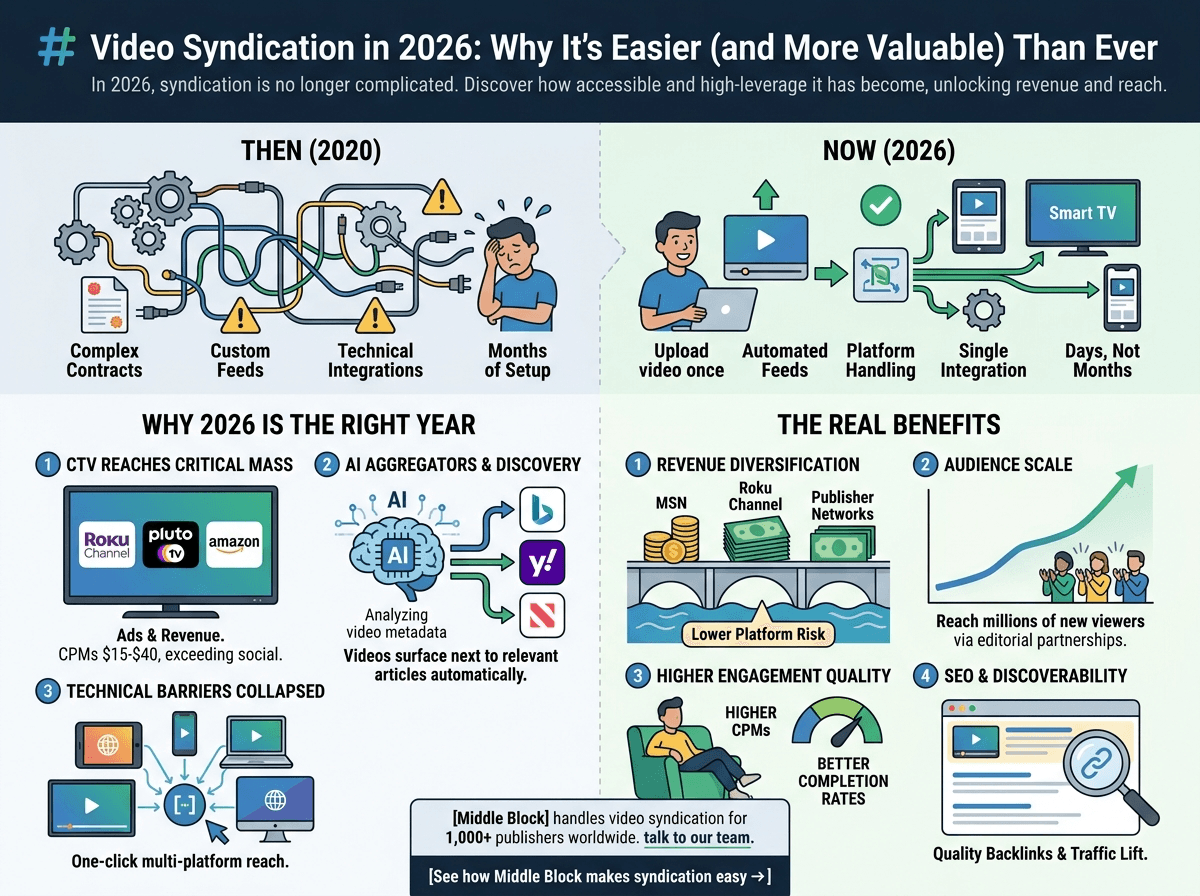
If you publish video content, you've probably heard about syndication — distributing your videos to MSN, Yahoo, Apple News, CTV channels, and other platforms that serve them to their own audiences. And you've probably assumed it's complicated. Complex contracts. Custom feeds. Technical integrations. Months of setup.
In 2026, that's no longer true. Video syndication has quietly become one of the most accessible and high-leverage things a video publisher can do — and the publishers who haven't adopted it yet are leaving meaningful revenue and reach on the table.
Here's what's changed, why it matters, and how easy it actually is to get started.
## What Video Syndication Actually Means
Video syndication is licensing your video content to third-party platforms that serve it to their existing audiences. Those platforms run ads against your content, and the ad revenue is shared with you. You supply the content; they supply the audience and the monetization.
This is fundamentally different from posting to social media. When you upload to TikTok or Instagram, you're submitting to an algorithm and hoping it serves your content to the right people. With syndication, the platform has already agreed to distribute your content. You have a distribution arrangement, not just an upload.
The key syndication channels in 2026:
- **Editorial platforms:** MSN Video, Yahoo News, Apple News, Flipboard, SmartNews, NewsBreak
- **Publisher networks:** Primis, Ex.co, and other contextual video networks that embed premium video alongside articles on publisher sites
- **CTV/FAST platforms:** Roku Channel, Amazon Fire TV, Pluto TV, Tubi, Xumo
Each channel reaches a different audience, in a different context, with different revenue dynamics. A diversified syndication strategy means your content is working across all of them simultaneously.
## Why 2026 Is the Right Year to Syndicate
Three shifts have made syndication dramatically more valuable than it was even two years ago.
### 1. CTV Has Reached Critical Mass
Connected TV viewership crossed traditional cable in 2025. By 2026, advertisers are spending serious money to reach household viewers on the largest screen. CTV CPMs (cost per thousand impressions) now run **$15–$40** — frequently 5–10x what publishers earn from the same content on social platforms.
A publisher with a Roku channel generating 100,000 monthly CTV views can earn more than the same publisher generating 1 million views on YouTube. The CPM math is that different.
Two years ago, getting onto Roku or Fire TV required engineering resources and platform relationships. In 2026, a properly formatted MRSS feed and a distribution partner is enough.
### 2. AI Aggregators Now Distribute Video at Scale
Search behavior is changing. Users increasingly get video recommendations from AI aggregators, news apps, and content discovery engines — not just from search and social. MSN, Yahoo, Apple News, NewsBreak, and similar platforms now use sophisticated contextual matching to surface video into article pages and reader feeds.
For publishers with syndicated feeds, this means your video gets recommended automatically. A well-tagged video about market volatility gets placed alongside finance articles across multiple platforms — discoverability you'd never achieve by posting to a single channel.
### 3. The Technical Barrier Has Collapsed
In 2020, video syndication required custom MRSS feed development, platform-specific format variations, ongoing maintenance as specs changed, and direct relationships with each receiving platform. Most publishers couldn't justify the engineering investment.
In 2026, distribution platforms handle all of this:
- Feeds generated automatically from your video catalog
- Partner-specific format variations applied without manual work
- Spec changes handled by the platform, not your team
- Single integration → access to 1,000+ destinations
The result: you can go from zero to actively distributed across major platforms in days, not months.
## The Real Benefits (With Actual Numbers)
Let's get specific about what syndication delivers in 2026.
### Revenue diversification
Publishers dependent on a single platform (YouTube, Facebook, TikTok) for both reach and revenue are one algorithm change away from a significant business disruption. Syndication creates parallel revenue streams across CTV, editorial, and aggregator channels — each with different risk profiles.
A typical syndicated video might generate revenue through:
- CTV ad impressions on your Roku channel
- Editorial placements on MSN with shared ad revenue
- Publisher network distribution via Primis or Ex.co earning per-view payouts
- Apple News+ time-based payouts (for subscription content)
One piece of content. Multiple monetization paths. Lower platform risk.
### Audience scale beyond what's organically possible
Editorial syndication regularly produces audience growth that would be impossible through organic channels alone. Independent publishers have reached **tens of millions of new viewers** in 90-day windows through editorial distribution — scale that previously required a traditional broadcast deal.
You're not competing for attention against the entire internet. You're being placed contextually next to articles your target audience is already reading.
### Higher engagement quality
Editorial and CTV audiences engage differently than social media viewers. CTV viewers watch on the largest screen in the household with intentional, lean-back attention. Editorial readers are already engaged with topical content when your video appears. Completion rates and ad engagement on these platforms run substantially higher than social.
Better engagement → higher CPMs → more revenue per impression.
### SEO and discoverability lift
Videos with structured metadata that appear across editorial platforms generate referral traffic back to your site, build domain authority through quality backlinks, and improve discoverability in video search results. Syndication is a content distribution strategy AND an SEO strategy in one.
### Operational efficiency
The same video you produced for your own site distributes everywhere automatically. No additional production. No platform-specific re-editing. No manual upload workflow. Your existing content library does more work without your team doing more work.
## What's Actually Required to Start
The minimum requirements for video syndication in 2026:
**Catalog:** Most platforms want at least 10–20 videos with a regular publishing cadence (weekly or better). If you publish video consistently, you already meet this bar.
**Clean metadata:** Proper titles, descriptions, categories, and keywords for each video. This is also good for your own SEO, so it's work worth doing regardless.
**Quality thumbnails:** High-resolution thumbnail images per video (ideally 1280×720 or larger). Most modern video CMSes generate these automatically.
**Rights clearance:** You need to own or have licensed the content you syndicate — including music, footage, and third-party clips. This is non-negotiable for editorial platforms.
**An MRSS feed:** The technical mechanism for distribution. Either generate this yourself, or use a platform that generates it automatically from your catalog.
That's it. If you're publishing video regularly with reasonable metadata, you're closer to being syndication-ready than you might think.
## How to Get Started
Three paths, depending on your situation:
### Path 1: Build it yourself
If you have engineering resources, you can build MRSS feeds from your CMS, negotiate platform relationships directly, and manage ongoing format variations. This works for very large publishers with dedicated infrastructure teams.
For most publishers, the engineering cost outweighs the value compared to using a distribution platform.
### Path 2: Use individual platform tools
Some receiving platforms (MSN, Yahoo, etc.) accept direct submissions or feeds. You can manage relationships one by one. The downside: every new platform is another integration, another contract, another spec to maintain.
This works if you're targeting one or two specific platforms strategically. It doesn't scale.
### Path 3: Use a distribution platform
A distribution platform handles MRSS generation, partner-specific formats, platform relationships, monetization, and reporting in one place. You upload video to one system; the system distributes everywhere. Revenue from all channels reports back to a single dashboard.
This is how most publishers approach syndication in 2026 because it converts what used to be an ongoing technical project into a managed service.
[Middle Block](/) handles video syndication for 1,000+ publishers worldwide — distributing premium video across MSN, Yahoo, Apple News, CTV platforms, Primis, Ex.co, and 1,000+ publisher endpoints with monthly transparent reporting. If you're ready to syndicate without the engineering investment, [talk to our team](/contact).
## The Bottom Line
In 2026, video syndication is no longer a technical project — it's a strategic decision. The barriers that used to make syndication feel inaccessible (custom feeds, platform negotiations, ongoing engineering maintenance) have largely collapsed. What remains is the upside: revenue diversification, audience scale, premium CPMs, and operational leverage on content you're already producing.
The publishers who started syndicating in 2024–2025 are now generating significant revenue from distribution channels that didn't exist or weren't accessible to them five years ago. The publishers who wait another year are watching that opportunity widen for everyone else.
If you produce video and you're not syndicating yet, the question isn't really *whether* to start. It's *which platform* to start with.
[See how Middle Block makes syndication easy →](/products/syndication)
— ABOUT THE AUTHOR
Marom Yvgi
BizDev
Marom has years of experience in business development with demonstrated skills establishing opportunities in video production and digital video publishing.
Connect on LinkedIn— READ NEXT
More from the team.



— LOOKING FOR SOMETHING SPECIFIC?
Talk to our team.
If you have questions about content syndication, partnerships, or the platform — we're here.